Commercial
Commercial Mold Insurance: What Is Actually Covered
Whether mold is covered usually comes down to the cause of the water. Here is how the coverage really works.
Commercial mold insurance rarely works the way property owners expect. Whether a policy responds to a mold loss usually comes down to one question, what caused the water, because a burst pipe and a slow roof leak are treated very differently even when the growth looks the same. This guide walks through how commercial property policies generally treat mold, where the common limits and exclusions sit, and why documentation and a prompt response matter so much to any claim.
General information, not coverage advice
This is a plain-language overview of how commercial mold insurance tends to work. It is not advice on your specific policy or claim. Every policy is different, and the only reliable read on your coverage is your own policy language and your agent or broker. Treat everything here as a starting point for that conversation.
Why the cause of the water decides almost everything
Mold is a symptom of moisture, and insurers know it. That is why most commercial property policies do not really ask whether you have mold, they ask what let the water in and how long it was there. The central distinction is between water that arrived suddenly and accidentally, and water that seeped in slowly over weeks or months.
A sudden and accidental event, such as a pipe bursting overnight or a rooftop unit failing during a storm, is the kind of loss property policies are built to cover. When mold grows as a direct result of that covered water damage, coverage for the mold cleanup is more likely to follow, subject to the limits described below. Damage that develops gradually, from long term humidity, a drip that was left unrepaired, or condensation inside a wall cavity, tends to fall under maintenance and wear, which policies generally exclude.
This is the same principle that governs residential policies, explained in the guide on whether insurance covers mold. The commercial version simply has larger numbers, more moving parts, and stricter documentation expectations.
Sudden and accidental versus gradual damage
The line between sudden and gradual is where most mold claims are won or lost, so it helps to see how the two look in practice. The examples below are illustrative, not a promise of how any particular policy will respond.
- Sudden and accidental: a supply line to a break room sink ruptures over a weekend and soaks a wall, with mold appearing days later. The water event is discrete, datable, and not the result of neglect.
- Sudden and accidental: a storm tears part of a roof membrane and rain enters before repairs can be made. The entry point is tied to a specific covered event.
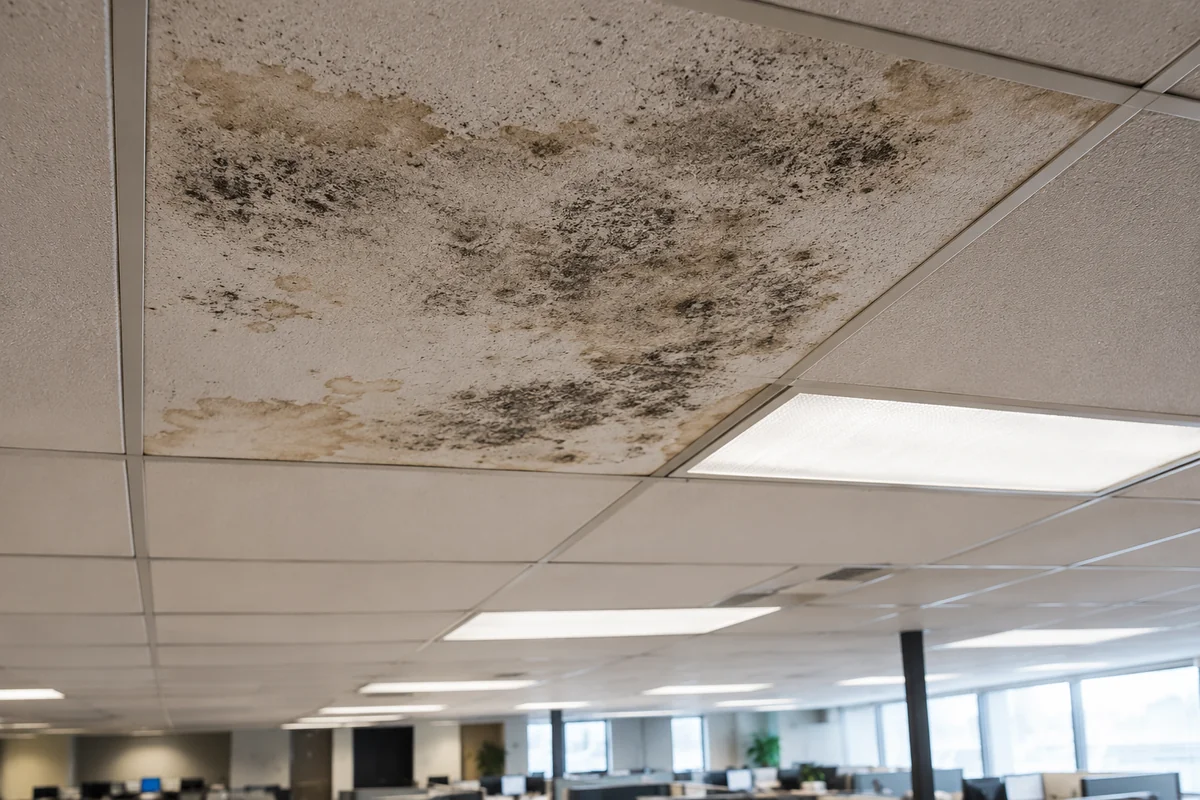
- Gradual: a flat roof has leaked slowly at a seam for a season, staining ceiling tile a little more each month until mold spreads through the deck above.
- Gradual: high indoor humidity in a warehouse keeps wall cavities damp year round, feeding steady growth with no single triggering event.
- Gradual: a known plumbing drip was noted in an inspection and left unaddressed, and mold followed.
The pattern is consistent. A datable event with an outside cause reads as sudden. A slow, foreseeable, or maintenance-related condition reads as gradual, and gradual mold is what most policies push back on. This is also why the timeline you can document often matters more than the size of the growth.
Mold sublimits: the number that surprises people
Even when mold is covered, the amount of coverage is usually far smaller than owners assume. After a wave of mold claims in the early 2000s, most insurers added a specific mold sublimit to commercial property policies, a separate and much lower cap that applies to mold regardless of the main policy limit.
A building might carry a property limit in the millions while its mold sublimit sits at a small fraction of that, sometimes in the tens of thousands. A large remediation in an occupied commercial building can run well past that figure once containment, material removal, drying, HVAC work, and clearance testing are added up. The gap between the sublimit and the real cost is where owners get caught.
The sublimit is usually an aggregate, meaning it can apply per policy period rather than per event, so a second mold loss in the same year may share what is left. Reading this number before a loss, not after, is one of the more useful things a property owner can do. To see how quickly commercial remediation costs climb toward and past a typical sublimit, the commercial mold remediation process guide walks through what the work actually involves.
Common mold exclusions to read for
Beyond the sublimit, several standard exclusions shape whether a mold claim goes anywhere. None of these are hidden, they are simply easy to overlook until a loss forces a close reading of the policy.
- A general fungus, mold, and rot exclusion that limits or removes coverage unless the mold results from a separately covered peril.
- A flood exclusion, since rising surface water and storm surge are typically covered only under separate flood insurance, and mold that follows a flood usually follows the flood exclusion.
- A maintenance, wear, and deferred-repair exclusion that captures most gradual moisture problems.
- A neglect provision that can reduce a payout if reasonable steps were not taken to protect the property after a loss.
- Sewer or drain backup, which is often excluded unless a specific endorsement was added.
The through line is that mold coverage rides on the peril underneath it. If the water source is itself excluded, the mold that grew from it is usually excluded too. That is why establishing the cause early, and matching it to a covered peril, is the practical heart of any commercial mold claim.
Business interruption and the income you lose
For many commercial owners, the cleanup bill is not the largest cost of a mold event. The larger cost is the income lost while a space sits unusable, and that is where business interruption coverage comes in. It is designed to help replace lost earnings and cover continuing expenses while operations are suspended by a covered loss.
The important catch is that business interruption coverage generally responds only when the interruption stems from a covered physical loss. If the underlying water event is covered and the mold cleanup forces you to close part of the building, business interruption may apply, though a mold sublimit or a specific waiting period can still limit it. If the mold traces back to an excluded gradual cause, the income loss usually is not covered either, because there was no covered event to trigger it.
Because business interruption terms vary so widely, from how the waiting period works to how the period of restoration is measured, this is one of the parts of a policy most worth reviewing with a broker before anything goes wrong.
Why documentation and a prompt response matter
Insurers pay claims they can verify. With mold, the most valuable evidence is the record that shows a sudden cause, a quick reaction, and reasonable steps to limit the damage. Weak documentation can turn a legitimately covered loss into a disputed one, purely because the timeline cannot be proven.
- 1 Document the water event as soon as it is found, with dated photos, the location, and what appears to have caused it.
- 2 Notify your insurer promptly, since late notice is a common reason claims run into trouble.
- 3 Take reasonable emergency steps to stop the water and dry the area, and keep receipts, because failing to mitigate can reduce a payout.
- 4 Bring in a licensed remediation contractor and, where useful, an independent certified hygienist to assess and scope the work in writing.
- 5 Keep every report, photo, message, invoice, and clearance result together as a single file tied to the loss.
This mirrors the disciplined paper trail a property manager builds for any moisture issue. The same logic drives the tenant mold complaint response playbook, which shows how to log, acknowledge, and document a complaint from the first report through clearance.
One point worth stressing: the site does not perform testing, remediation, or clearance, and does not adjust claims. It connects owners with licensed local pros who do that work, and their independent reports are often exactly the documentation an insurer wants to see.
Endorsements that can broaden coverage
If the standard mold sublimit looks too low for a given building, coverage can sometimes be broadened at renewal through endorsements. These are optional add-ons that adjust the policy for an extra premium, and their availability depends on the insurer, the building, and its loss history.
- A higher mold or fungus sublimit, raising the cap closer to the real cost of a large remediation.
- Sewer and drain backup coverage, which addresses a common source of water that a base policy often excludes.
- Equipment breakdown coverage, which can respond when an HVAC or mechanical failure is the source of the water.
- A broadened water damage endorsement that adjusts how certain water events are treated.
- Expanded business interruption terms, such as a longer period of restoration or extended coverage after reopening.
Endorsements are a conversation for renewal time, guided by a broker who knows the building and its risks. The point is simply that the base policy is a starting position, not a fixed ceiling, and a building with real exposure may be worth insuring more carefully than the default terms allow.
How insurance interacts with liability
Property coverage and liability are two different things, and mold can touch both. Property coverage addresses damage to your own building. Liability coverage comes into play when a third party, a tenant, a customer, or an employee, claims harm from mold in a space you control. Many commercial general liability policies contain their own mold or pollution exclusions, so this coverage cannot be assumed either.
The distinction matters most for owners and managers who lease space to others, because a tenant complaint can raise both a property question and a liability question at once. The guides on business liability for mold and mold landlord versus tenant responsibility go deeper on who is responsible and when, which in turn shapes which policy, if any, responds.
Commercial mold insurance questions
Does commercial property insurance cover mold?+
Sometimes, and usually only when the mold results from a covered, sudden, and accidental water event such as a burst pipe. Mold from gradual moisture, deferred maintenance, or flooding is commonly limited or excluded, and even covered mold is typically capped by a mold sublimit.
What is a mold sublimit?+
It is a separate, lower cap that applies specifically to mold, independent of the main property limit. A building can carry a large overall limit while its mold sublimit sits at a small fraction of that, which is why a big remediation can exceed the available coverage.
Why does the cause of the water matter so much?+
Because mold coverage generally rides on the peril underneath it. If the water came from a covered sudden event, the resulting mold is more likely to be covered. If the water source is itself excluded, such as flood or gradual seepage, the mold that grew from it is usually excluded too.
Will business interruption cover lost income during a mold cleanup?+
It may, but generally only when the interruption stems from a covered physical loss. If the underlying water event is covered and the cleanup forces a closure, business interruption can apply, though sublimits and waiting periods may limit it. If the mold traces to an excluded gradual cause, the income loss is usually not covered.
What documentation helps a commercial mold claim?+
Dated photos of the water event and the growth, a clear record of when it was found and reported, receipts for emergency drying and mitigation, and written assessments from a licensed remediation contractor or an independent certified hygienist. A prompt, well-documented timeline is often what separates a paid claim from a disputed one.
Can I add mold coverage if my sublimit is too low?+
Often yes, through endorsements at renewal, such as a higher mold sublimit, sewer and drain backup, or equipment breakdown coverage. Availability and cost depend on the insurer, the building, and its loss history, so this is a conversation to have with a broker before a loss rather than after.
Handling a mold issue in a building you own or manage?
A licensed local pro can assess the problem and produce the written documentation an insurer expects to see.
Getting the most from commercial mold insurance comes down to a few habits practiced before a loss and during one. Read the mold sublimit and exclusions closely so there are no surprises, document the cause and timeline the moment water appears, respond promptly to limit the damage, and bring in a licensed remediation contractor whose written record supports the claim. Coverage almost always turns on whether the water was sudden and accidental rather than gradual, so the cause you can prove is the coverage you are likely to get.
A tenant reported mold?
Follow a documented response that protects you, step by step.