Commercial
Mold in Office Buildings: A Facilities Manager's Guide to Response
What facilities managers, building owners, and tenants need to do when musty air or visible growth turns up at work
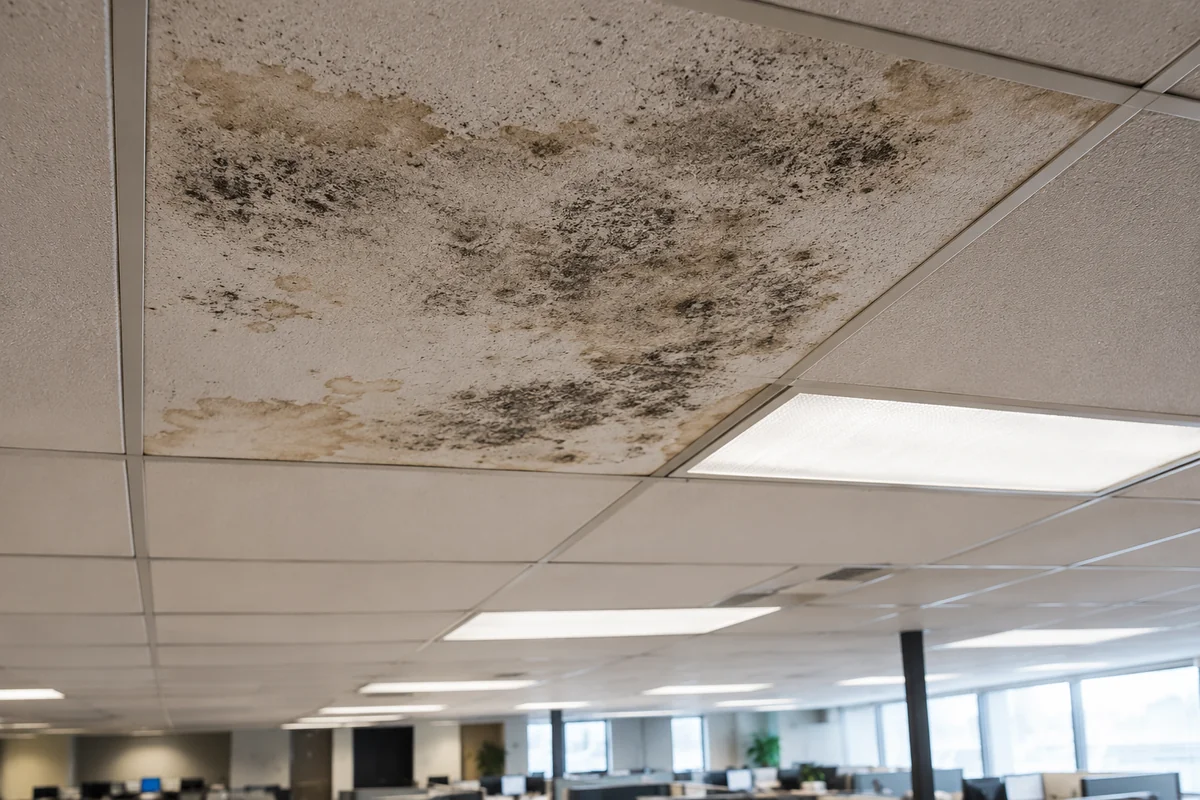
Mold in office buildings rarely announces itself with a dramatic black stain on a lobby wall. It shows up as a persistent musty smell near a return vent, a cluster of headache complaints from one corner of the third floor, or a soft brown ring on ceiling tile above a break room. By the time it is visible, moisture has usually been feeding it for weeks. If you manage, own, or lease commercial space, your job is not to diagnose a health condition or to grab a scraper yourself. Your job is to control the moisture, protect the people in the building, document what you find, and get a licensed professional involved before a small area becomes a floor-wide problem.
Why commercial buildings grow it differently than homes
A house has a handful of moisture sources and one household to notice them. A commercial building has dozens of sources, shared air, and hundreds of occupants who each experience the space differently. The scale changes both the risk and the response. A leaking supply line above a dropped ceiling can wet insulation and tile for days before anyone reports the water stain, because nobody lives under that spot the way a homeowner lives above their own basement.
The mechanical systems are the biggest difference. Central HVAC moves conditioned air through long runs of ductwork and across cooling coils that drip condensate all summer. If a drain pan overflows or a coil stays wet, the system can distribute spores across an entire floor rather than confining the problem to one room. That shared-air factor is why a complaint in one office can trace back to equipment two rooms away, and why the same failure modes that plague homes with ducted systems, covered in our guide to mold in HVAC and air ducts, scale up sharply in a commercial setting.
Occupancy patterns matter too. Setback thermostats that let temperature and humidity drift on nights and weekends, tightly sealed envelopes built for energy efficiency, and dense furniture layouts that block airflow all create pockets where humidity lingers. None of these are defects. They are ordinary features of modern commercial space that, combined with any water source, give mold what it needs.
Where mold hides in office space
Growth follows water, and water in an office building collects in predictable places. Knowing the usual suspects lets you inspect efficiently instead of chasing a smell around the floor plate. When a complaint comes in, walk these locations first.
- Above dropped ceilings, where roof leaks, condensate lines, and supply-pipe drips wet the tile and the insulation from the top down
- Around and inside HVAC air handlers, cooling coils, drain pans, and the first few feet of duct, especially units that run humid and cold
- Behind and beneath kitchenette and break-room fixtures, dishwashers, ice machines, and under-sink supply lines
- At exterior walls and window perimeters where the building envelope leaks air and allows condensation, common on north faces and older curtain-wall glazing
- In basements, parking levels, and mechanical rooms with slab moisture, sump activity, or poor ventilation
- Under carpet and behind baseboards in any area that has taken on water, since padding and glue hold moisture long after the surface looks dry
- Inside wall cavities near restrooms and plumbing chases, where a slow drip stays hidden until the drywall stains
The pattern to notice is that most of these are places nobody looks during a normal day. That is exactly why the smell often arrives before the sight. Trust the musty odor as a real signal and start opening ceiling tiles and access panels rather than waiting for a stain to confirm it.

How to read occupant complaints
In a commercial building, the first evidence is usually a person, not a stain. Someone reports stuffy air, a lingering headache, an itchy throat that clears up on the drive home, or a smell they cannot place. These reports are worth taking seriously as building signals, and they are worth handling carefully, because they involve health and they can involve tenant relations.
The federal agencies are clear on the framing. The EPA and CDC both note that damp indoor spaces are associated with symptoms like congestion, coughing, and eye or throat irritation in some people, and that individuals vary widely in how they react. What that means for you as a manager is simple: act on the building, and let people act on their own health. You address the moisture and the growth. You do not diagnose anyone, promise a symptom will resolve, or tell an occupant whether they should see a doctor. If someone raises a health concern, the right response is to acknowledge it, log it, direct them to their own physician for medical questions, and get moving on the source.
Keep a complaint log from day one
Record who reported what, where, and when, plus the date and outcome of every inspection and repair. A dated log protects occupants by driving faster fixes, and it protects the building owner if a complaint later escalates. It is the single most useful habit in managing indoor air quality issues.
Watch for clustering. One person with a stuffy nose is hard to interpret. Three people along the same wall, or a spike in complaints after a rainstorm or an HVAC change, points at a physical cause you can find and fix. Map complaints against the floor plan and you will often see the moisture source before you ever open a ceiling tile.

First response: contain the moisture, not the panic
When you confirm a problem, the instinct is either to ignore it or to overreact and evacuate a floor. Neither is usually right. The productive first moves are about stopping water and limiting spread while you line up a professional. These steps buy time and reduce the eventual cost of the work.
- 1 Find and stop the water source if you safely can, whether that means shutting a valve, cutting power to a leaking appliance, or getting a roofer on a leak. Mold cannot grow without moisture, so this is always step one.
- 2 Isolate the area. Close off a visibly affected room, avoid disturbing suspected growth, and do not run fans or the HVAC in a way that pushes air from the affected zone across the rest of the floor, which can spread spores.
- 3 Protect occupants sensibly. Relocate anyone working directly next to visible growth or standing water. You do not need to clear a floor for a small stain, but do not ask people to sit inside an obviously affected space.
- 4 Document everything with photos and notes before anything is touched or dried, since insurers and remediation contractors both need to see the original condition.
- 5 Call for a professional assessment rather than scraping or bleaching a large area yourself. Disturbing extensive growth without containment can make the air quality worse, not better.
That last point is where commercial and residential guidance diverge. A homeowner can reasonably clean a small patch of bathroom grout. In a shared workplace, disturbing anything beyond a very small, well-defined spot risks distributing spores through occupied space and shared air, which is a different order of problem. When the affected area is larger than a small patch, or you are not certain how far it extends behind a surface, that is the line where you bring in a licensed professional. Our residential explainer on when a mold problem needs a pro walks through the size and situation thresholds, and the logic scales up for a workplace.
Testing, assessment, and what the numbers actually tell you
Building owners often ask for an air test first, assuming a number will settle the question. It usually will not, at least not on its own. The EPA does not set numerical mold limits for indoor air, and there is no federal threshold that declares a space safe or unsafe. What a qualified assessment does is find the moisture source, map the extent of growth including hidden areas, and scope the work. Sampling is a supporting tool, most useful for comparing an affected area to a clean baseline or for confirming a space is ready to reoccupy after work, not as a standalone verdict.
For a commercial job of any size, the cleaner arrangement is an independent assessor who inspects and writes the protocol, and a separate remediation contractor who performs the work to that protocol. Separating the two removes the conflict of interest that comes from having the same firm both diagnose the problem and sell the cure. The independent assessor can also verify the work at the end. Any testing, inspection, and clearance is performed by the licensed and certified professionals in the network, not by this resource. We do not test, inspect, or perform abatement.
If you are weighing whether testing is worth the cost at all, the reasoning in should I test for mold applies to commercial decisions too: test when it will change what you do, not to generate a report that sits in a drawer. A confirmed water stain with visible growth generally needs remediation regardless of what an air sample says.
The remediation process in a commercial building
Professional remediation in an occupied building follows a recognized sequence built around containment. The goal is to remove the growth and the moisture source without contaminating the rest of the workplace, and to do it while, in many cases, the building keeps operating. Understanding the sequence helps you plan around it and ask contractors the right questions.
- 1 Assessment and protocol: an inspector defines the affected area, identifies the moisture cause, and writes the scope of work and clearance criteria.
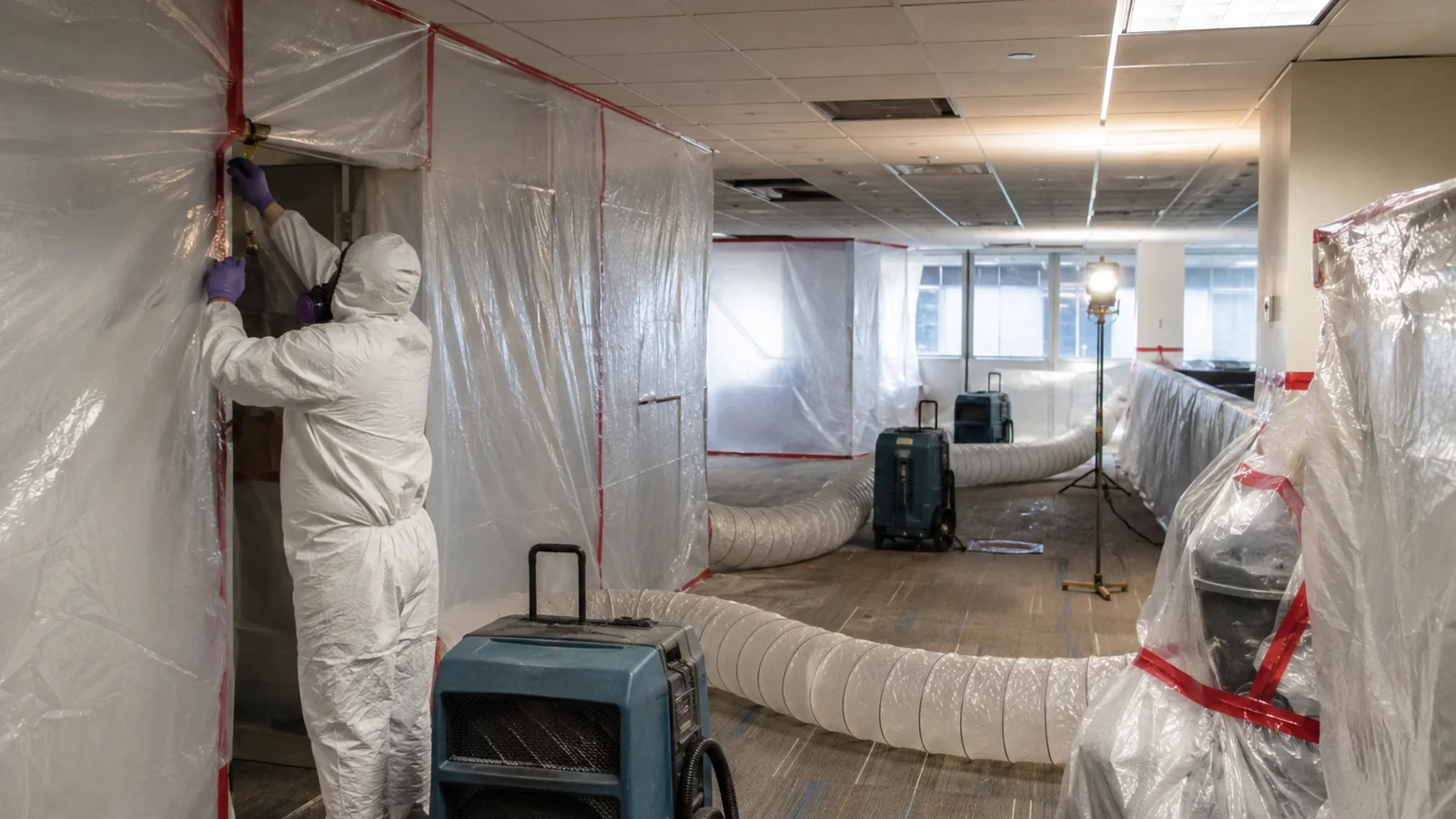
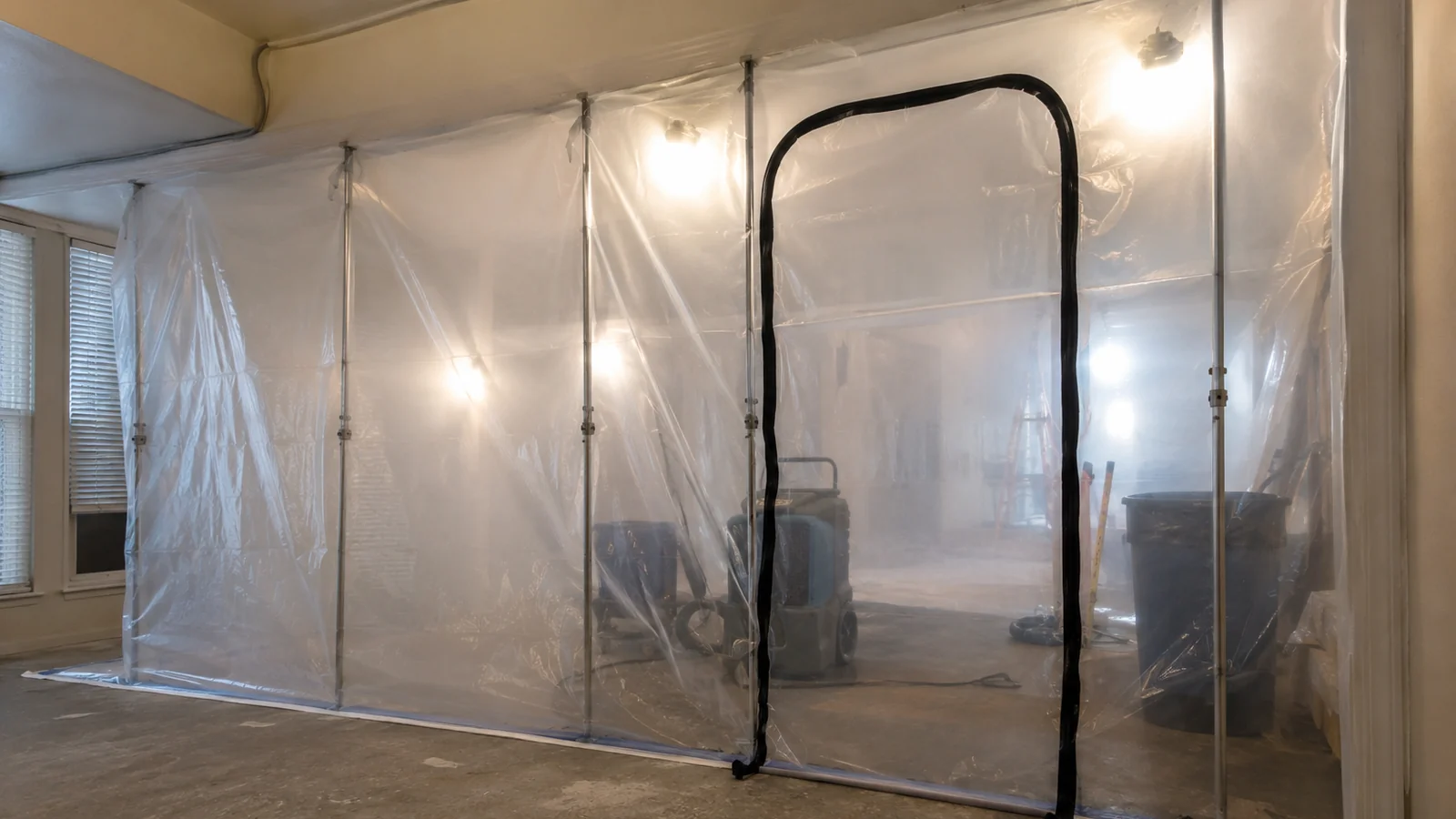
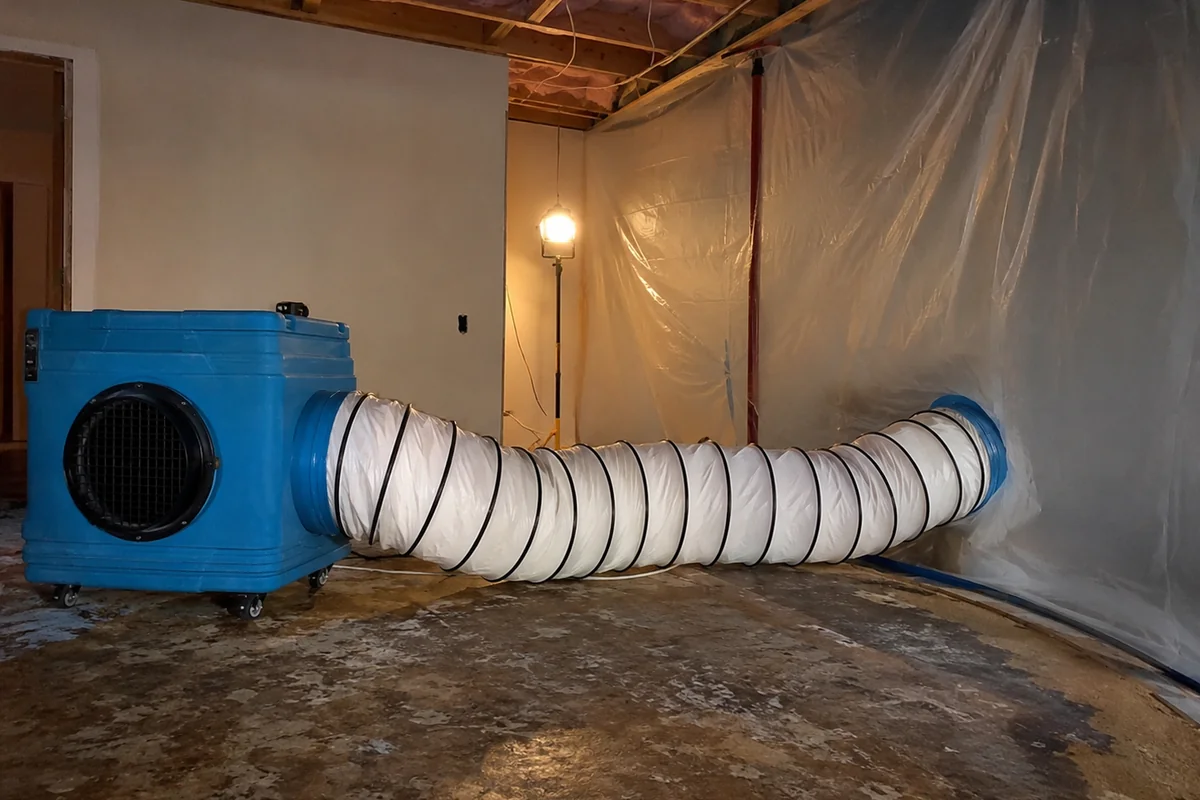
- 2 Containment: crews seal the work zone with plastic barriers and set up negative air pressure with HEPA-filtered machines so spores cannot drift into occupied space.
- 3 Moisture correction: the underlying leak, condensation, or humidity problem is repaired, because remediation without fixing the source only resets the clock.
- 4 Removal: porous materials that cannot be cleaned, such as saturated drywall, ceiling tile, insulation, and carpet padding, are removed and bagged inside containment.
- 5 Cleaning and HEPA vacuuming: remaining surfaces are cleaned and the air is filtered until the space is visibly and measurably clean.
- 6 Drying and clearance: the area is dried to normal moisture levels, then an independent check confirms the space meets the clearance criteria before reoccupancy.
Scheduling is a real commercial consideration that homes never face. Larger jobs are often staged after hours, over a weekend, or floor by floor to keep the business running. A good contractor will talk through phasing, dust and noise control, and how to route occupants around the work. Our overview of how professional mold remediation works explains the containment logic in more detail, and the commercial mold remediation guide covers the workplace-specific playbook end to end.
Budgeting and insurance for commercial mold work
Commercial remediation cost depends on the affected square footage, how much is hidden inside walls and ceilings, the materials involved, whether the work must happen after hours, and how far the moisture has traveled. A single wet ceiling tile and a small drywall patch is a modest job. Growth that has moved through a wall cavity, into insulation, and across an HVAC run is a much larger one. Because so much depends on hidden extent, early professional assessment usually saves money by catching the true scope before it grows.
To get a rough sense of the range before contractors visit, you can start with our commercial mold remediation cost estimator, which frames the variables that drive a workplace quote. Treat any early figure as a planning number, not a bid. The real number comes from a walkthrough of your specific space.
Insurance is its own puzzle in commercial coverage. Many commercial property policies treat mold cautiously, often covering it only when it results from a sudden and accidental covered event like a burst pipe, while excluding damage tied to long-term maintenance issues or gradual leaks. Some policies carry a specific mold sublimit. The practical lesson is to document the triggering event and your response promptly, and to read your policy's mold language before you need it. Our commercial mold insurance guide breaks down the common coverage terms and the documentation that supports a claim.
The single biggest cost lever
Time. Mold does not pause between the leak and the repair. Every extra day of moisture expands the affected area and the eventual bill. Fast source control and rapid 24/7 professional response are the most reliable ways to keep a small problem small.
Who is responsible, owner or tenant
In leased commercial space, the first question after discovery is often who pays and who acts. The answer lives in the lease. Commercial leases vary far more than residential ones, and a triple-net lease can push maintenance and repair obligations onto the tenant that a homeowner would never expect. Read the maintenance, repair, and casualty clauses, and note who controls the systems involved. If the moisture comes from the base building HVAC or the roof, that usually points at the landlord. If it comes from a tenant's own kitchenette or a supplemental unit they installed, the responsibility may flow the other way.
Because these disputes turn on lease language and local law, this is a spot to get specifics from your own counsel rather than a general rule. What we can do is map the common allocation patterns. Our guide to mold landlord versus tenant responsibility lays out how commercial leases typically split the duty, and if a tenant is the one raising the alarm, the tenant mold complaint response guide covers how to handle the report professionally and on the record.
Preventing the next one
Once a building has had one moisture event, the cheapest future is one where the next leak gets caught in days rather than weeks. Prevention in commercial space is mostly about maintaining the systems that manage water and watching the conditions that let mold start. None of it is exotic. It is discipline applied to the moisture sources you already know about.
- Keep indoor relative humidity in a controlled range, generally below the low 60s, and do not let weekend setbacks allow humidity to climb unchecked in humid climates
- Service HVAC on a schedule: clean coils, clear and treat condensate drain pans and lines, replace filters, and confirm drainage actually flows
- Inspect the roof, flashings, and building envelope on a regular cadence and after major storms, since a small roof leak is the classic hidden feeder
- Respond to any water intrusion fast and dry affected materials within a day or two, because that window is when you either stop mold or invite it
- Walk mechanical rooms, basements, and parking levels periodically to catch slab moisture, sump problems, and standing water early
- Take occupant reports of musty smells seriously and inspect promptly rather than waiting for a visible stain
That last habit is worth repeating because it is the one that costs nothing. The smell almost always precedes the sight. A manager who treats a musty complaint as a work order rather than a nuisance catches problems while they are still cheap.
Frequently asked questions
Do we have to close the office if we find mold?+
Not usually. A small, contained area rarely requires clearing a floor. The sensible moves are to relocate anyone working right next to visible growth or standing water, avoid disturbing the area, and get a professional assessment. Full or partial closure is a judgment call for larger contamination, and a qualified assessor can advise on it. Avoid running the HVAC in a way that spreads air from the affected zone in the meantime.
Is there a legal mold limit we are violating?+
There is no federal numerical limit for mold in indoor air. The EPA does not set one, and OSHA has no specific mold standard, though general workplace safety duties still apply. Because there is no threshold to test against, assessment focuses on finding moisture and mapping growth rather than hitting a number. Legal exposure questions belong with your own counsel, not a general guide.
Should we test the air before doing anything?+
Often you do not need to. If there is a visible water stain with growth, remediation is warranted regardless of an air number. Testing is most useful to compare an affected area to a clean baseline or to confirm a space is ready to reoccupy after work. The reasoning in [should I test for mold](/residential/should-i-test-for-mold/) applies to commercial decisions too: test when it will change your action, not just to produce a report.
Can our janitorial staff just clean it with bleach?+
For anything beyond a very small, well-defined spot on a hard surface, no. Disturbing larger growth without containment can push spores through occupied space and shared air, making air quality worse. Porous materials like drywall, ceiling tile, and carpet padding usually cannot be salvaged by surface cleaning at all. Larger areas call for the licensed professionals in the network, who work under containment.
Who pays, the landlord or the tenant?+
It depends on the lease and the source of the moisture. Base-building systems like the roof and central HVAC usually point at the landlord, while a tenant's own installed fixtures may point at the tenant. See [mold landlord versus tenant responsibility](/commercial/mold-landlord-vs-tenant-responsibility/) for the common patterns, and confirm specifics with your counsel.
How do we find a qualified contractor for a commercial job?+
Look for firms that hold the relevant remediation certifications, carry appropriate insurance, and are willing to work to an independent assessor's protocol. You can [find a vetted local pro](/find-a-pro/) through the network, and every license and certification belongs to those professionals, not to this resource.
Commercial mold, in the field

Mold in a building you manage?
Follow a documented response that protects you from the first complaint through clearance testing.
Managing mold in office buildings comes down to a short, repeatable discipline: control the moisture, take occupant reports seriously, document as you go, and bring in a licensed professional before a small area becomes a floor-wide expense. You do not need to diagnose health effects or perform the work yourself, and you should not. What you do need is to move fast on water, keep a clear record, and connect the building to the right qualified pro. When you are ready, you can find a local remediation professional in the network to assess your space and scope the work.
A tenant reported mold?
Follow a documented response that protects you, step by step.